Our History and Management Style
First off, we are stewards of God’s herd. What I mean by that is, he owns everything, and it is His herd that we oversee. Christ is the center of the operation. He comes first above all else.
In 2012, Casey and I were given two dairy goats. In a couple years, we grew our herd. Then, in 2016, we decided to cull the herd because we were tired of the worms and the maintenance it took to keep the dairy goats going. I started researching different breeds of goats. I knew there had to be a better breed for our system. I found the Spanish goat and was hooked. I had narrowed it down to Koy or Kensing. The more I studied, the more the Kensing's intrigued me. In 2018, Vroman Spanish Goats was founded. It is made up of my wife Casey, our daughter, and myself, along with my dad (a retired veterinarian) who helps work goats and shares his knowledge of animals.
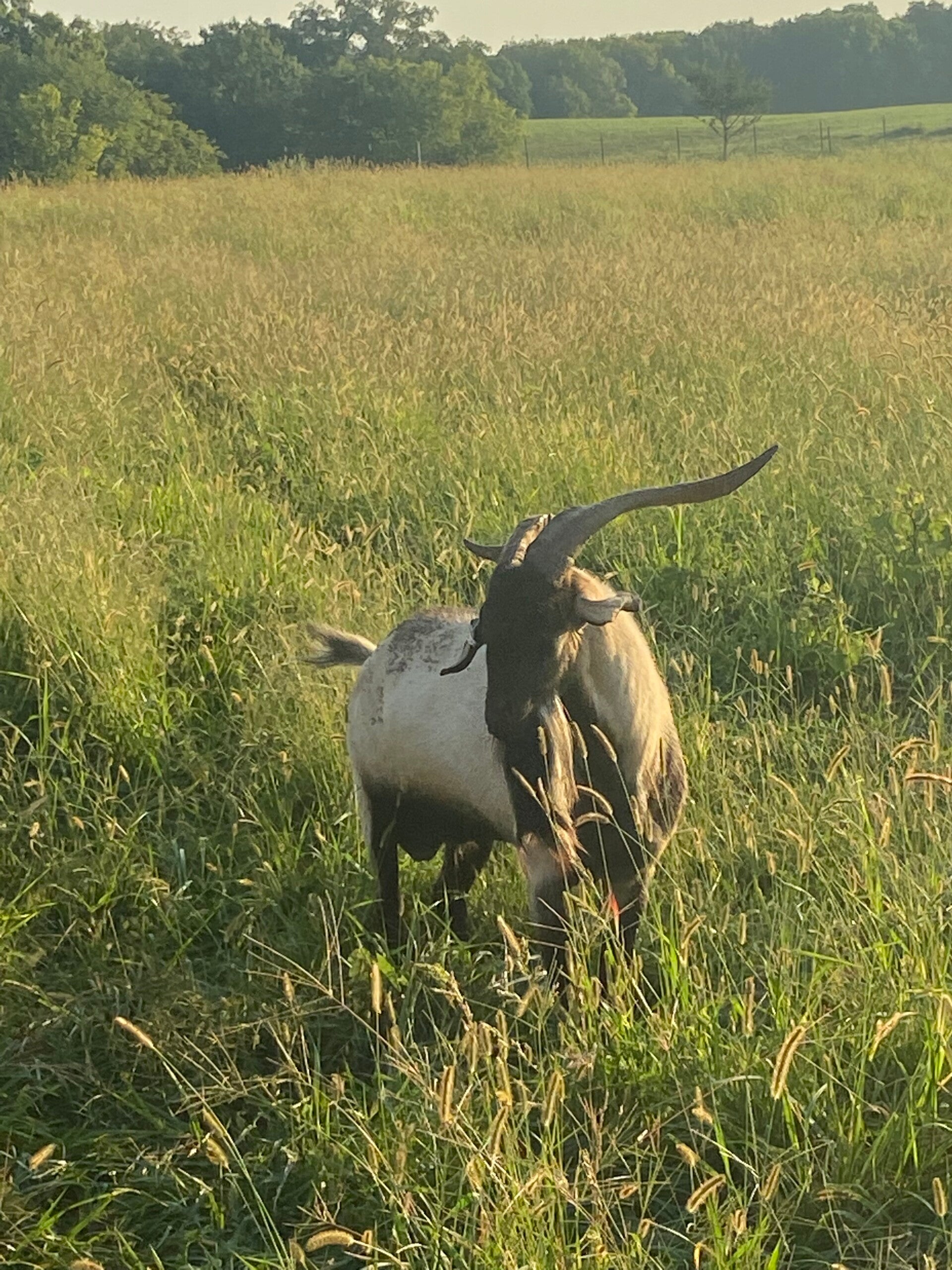
The Kensing bloodline is what we run. Our farm is in central Missouri, just outside of a small town called Fayette. We run are operation by rotational grazing, using electric netting and hot wire. Our goats work for a living. They are supplemented with some grain, hay in the winter, loose mineral, and an occasional protein block, depending on the grass. We kid in the pasture in early to late spring. We believe in a hands-off approach. We do not believe in bottle babies. If we have any, we get them going and sell them or give them away. A nannie must be able to raise her kids on her own, even if they are triplets. We expect our Kensing's to handle parasites, be good moms, be able to thrive and survive on their own with little input, on pasture 365 days a year. CDT shots are given once a year and copper bolus is given twice a year. We give no other vaccines.
We select for parasite resistance, mothering ability, conformation, and hardiness. Selecting for color isn’t even a thought, this trait doesn’t make the goat. We cull for worms (if they need to be wormed twice in their adult life, they are culled), conformation, bad mothering abilities, lack of toughness, unproductiveness, and lack of vigor. We do not breed are females until they are 15-17 months, so they kid at around 2 years of age.
Our bucks are selected for parasite resistance, vigor, conformation, and stature (athletic, long-bodied, tall and good horns). In our operation, parasite resistance is the most important trait. Lastly, we want to select with an old school approach, upholding the standards set forth from the foundation ranches. We want our goats to perform in a range base setting.
Lastly, we are striving to preserve the Spanish breed one goat at a time. We really are working to always improve are herd by each generation. We have added the Bradshaw bloodline this year. Which is exciting because we are the second breeder in the United States to have this bloodline. The first breeder is Jeremy Wrenke. He has work for years to keep this bloodline intact while improving it every year. The Bradshaw's are cut from a different goat. When you get ahold of one to work it, its like getting ahold of a half rabid wolverine. There made to be a range goat and left alone. They have such a vigor to live and are just a hard knocking goat.